
Hair Loss: Why It Happens and How to Treat It, Part 1
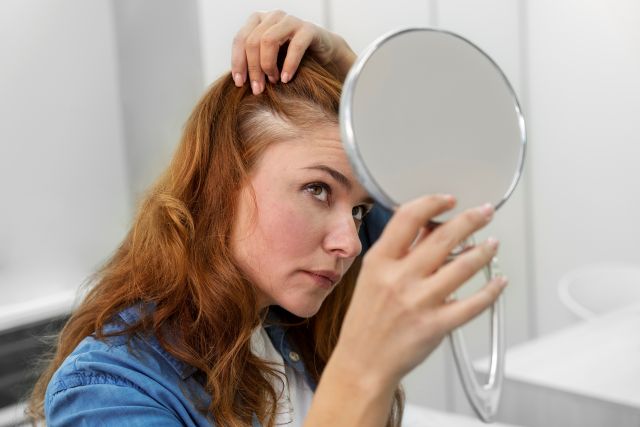
Hair loss is one of the most common complaints encountered by specialists in daily practice. However, despite its prevalence, this problem is often perceived as insignificant and not requiring attention. As a result, treatment is either not carried out at all or is limited to superficial recommendations. This approach leads to the real cause of hair loss being overlooked, and most often stress is assumed to be the cause.
But hair loss can have different origins, different courses, and different prognoses. Without understanding the cause, it is impossible to determine whether the process is temporary and reversible or requires more serious intervention. There are causes that lead to irreversible consequences, and in these cases hair will not grow back, however it can be preserved if the problem is identified in time and treatment is started.
Therefore, the key task is not simply to note the presence of hair loss, but to determine its type and cause in order to choose the correct treatment plan.
Physiology of Hair Growth
Hair growth is a continuous cyclical process in which each hair goes through several phases. These phases alternate throughout life, and it is their balance that determines hair density and condition.
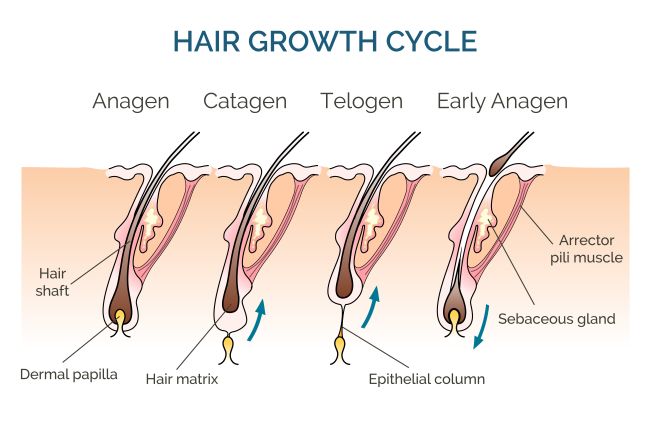
At the base of each hair is the bulb (bulb), inside which is the cell division zone (matrix) — this is where the hair is formed. Cells actively divide, gradually compact, and transform into the hair shaft.
This zone directly depends on blood supply — oxygen and nutrients are delivered to it through blood vessels. Without this process, cell division and hair growth are impossible.
The activity of this zone is regulated by the dermal papilla — a structure at the base of the follicle that transmits signals determining whether hair growth will occur. It initiates cell division, maintains this process, and determines whether a new hair will be formed.
If the dermal papilla functions, the follicle is capable of producing hair. If it is damaged or destroyed, hair growth becomes impossible.
There are three main phases: anagen, catagen, and telogen, with the beginning of a new cycle including early anagen.
Anagen is the phase of active hair growth. During this period, the cell division zone is actively functioning, and the dermal papilla is in close contact with it and transmits growth signals. As a result, the hair increases in length. This is the longest phase and lasts on average from three to six years.
Catagen is a short transitional phase in which hair growth stops. Cell division ceases, the dermal papilla detaches from the growth zone, and the follicle begins to shrink. This is the stage of completion of the active phase and lasts several weeks.
Telogen is the resting phase. During this period, the hair no longer grows and remains in the follicle without connection to the active growth zone. The dermal papilla is in an inactive state. After several months, the hair sheds. Normally, about 10–15% of hairs are in this phase.
After this, early anagen begins — the stage of initiating a new cycle. The dermal papilla shifts, begins to move toward the growth zone, reconnects with the cell division zone, and initiates a new cycle. Cells begin to actively divide, and a new hair is formed.
It is important that during normal hair shedding, the dermal papilla is preserved, and it is precisely this that allows a new growth cycle to begin.
Daily hair loss is a physiological norm and amounts to about 100–150 hairs per day. This reflects natural renewal: some hairs complete their cycle while new ones form in their place.
A problem arises when the balance of growth phases is disrupted: too many hairs simultaneously enter the resting phase or the duration of the active growth phase shortens. In this case, hair loss becomes noticeable and hair volume decreases.
Types of Hair Loss
Hair loss is not a single process, but several different conditions that differ in cause, course, and prognosis.
Hair loss that looks the same can have different origins, so without determining the type, it is impossible to understand what is happening and how to treat it.
In practice, several main types are identified.
Telogen effluvium is a condition in which a significant number of hairs prematurely transition from the growth phase to the resting phase. Hair stops growing earlier than expected and begins to shed after several months. Hair loss is usually diffuse across the entire scalp and is often associated with stress, illness, or another triggering factor. In most cases, this condition is reversible if the cause is addressed.
Anagen effluvium is hair loss during the growth phase. In this case, hairs do not transition into the resting phase but are damaged and shed directly during active growth. This occurs due to toxic factors that disrupt cell division, for example during chemotherapy. Hair loss develops rapidly and can be severe.
Androgenetic alopecia is a chronic process associated with follicle sensitivity to the hormone dihydrotestosterone (DHT). Under its influence, follicles gradually shrink, and hairs become thinner, shorter, and weaker. In men, the frontal-temporal areas and crown are more commonly affected; in women, the central part of the scalp is affected with preservation of the hairline.
Alopecia areata is an autoimmune condition in which the immune system affects hair follicles. It presents as well-defined patches of hair loss. The course can vary from spontaneous recovery to progression.
Deficiency-related hair loss is associated with a lack of resources necessary for follicle function. Most commonly, this includes deficiencies of iron, protein, zinc, vitamin D, and other elements. In this case, the follicle cannot maintain a normal growth cycle, and hairs either transition into the resting phase or grow weaker.
Inflammatory hair loss occurs in the context of scalp inflammation. This disrupts normal follicle function, slows hair growth, and increases shedding. It can be seen, for example, in seborrheic dermatitis or chronic scalp irritation.
Mechanical hair loss is the result of physical воздействие on the hair or follicles. This includes constant tension (tight hairstyles), friction, hair pulling (trichotillomania), or other traumatic factors. In this case, the hair is removed forcibly rather than as part of the natural cycle. If the follicle and dermal papilla remain intact, hair growth continues. With prolonged and repeated exposure, the growth cycle can be disrupted and areas of uneven hair density may form.
Scarring alopecias are conditions in which hair follicles are destroyed and replaced by connective tissue. In these areas, hair can no longer grow because the structure responsible for growth is lost. Treatment of this type of alopecia is most critical to begin as early as possible.
Key Mechanisms of Hair Loss
Hair loss is based on a combination of mechanisms that affect the hair growth cycle and the condition of the follicle. Hair does not fall out on its own — the body alters its cycle in response to internal signals.
Follicle regulation (growth vs rest) — the hair follicle constantly receives signals that determine whether the hair will continue growing or transition into the resting phase. This decision is formed at the cellular level of the follicle, primarily in the dermal papilla, and depends on the balance between stimulating and inhibiting factors.
Changes in hair growth phases — under the influence of various factors, a shift in the cycle occurs: shortening of the anagen phase and an increase in the proportion of hairs in telogen. This leads to increased shedding and reduced hair volume.
Hormonal influence (DHT) — sensitivity of follicles to dihydrotestosterone leads to a gradual decrease in their activity, shortening of the growth phase, and follicle miniaturization.
Inflammation — disruption of the balance between pro-inflammatory and anti-inflammatory signals suppresses follicle activity and promotes transition of hair into the resting phase.
Immune mechanisms — changes in immune system regulation can lead to damage to hair follicles and impairment of their function.
Disruption of signaling pathways (Wnt/β-catenin, VEGF) — these systems regulate the initiation of hair growth, follicle regeneration, and their nutrition. Their imbalance leads to reduced growth and increased hair loss.
Metabolic and nutritional factors — deficiency of protein, iron, zinc, and other elements limits the follicle’s ability to maintain the active growth phase.
Impaired microcirculation and blood supply — reduced delivery of oxygen and nutrients lowers the metabolic activity of the follicle.
Hypoxia and oxidative stress — damage follicle cells and disrupt their function.
Neuroendocrine influence (stress axis) — increased levels of stress hormones alter the regulation of the hair growth cycle.
Fibrosis around the follicle — gradual replacement of normal tissue with connective tissue reduces the ability of hair to grow and may lead to irreversible changes.
Dysfunction of follicular stem cells — leads to reduced capacity for regeneration and initiation of new hair growth.
Epigenetic regulation — changes in gene expression affect the sensitivity of the follicle to hormones and other signals.
Scalp microbiome — changes in the composition of microorganisms can sustain inflammation and affect follicle condition.
Sebum and lipid signaling — changes in the composition of sebum affect the local environment and regulation of hair growth.
Hair loss is the result of a complex impact on the follicle at the level of signals, cells, and the surrounding environment, leading to disruption of the hair growth cycle.
Causes and Triggers of Hair Loss
Hair loss does not occur on its own. In each case, there is a factor or a combination of factors that trigger changes in follicle function and shift the hair growth cycle.
The same type of hair loss can be caused by different reasons, so it is important to evaluate not only the pattern of hair loss but also the factors that led to it.
One of the most common causes is infections, especially viral ones. After an illness, the body temporarily reallocates resources, and some hairs prematurely transition into the resting phase. This is typical for conditions following severe infections, including post-viral syndromes such as long COVID.
Psychological and emotional stress also plays a significant role. It alters the body’s regulation and can lead to premature termination of the hair growth phase. At the same time, hair loss itself can increase stress and sustain this process.
A common cause is hormonal changes. Thyroid dysfunction, changes in sex hormone levels, as well as age-related changes such as menopause, directly affect follicle behavior and the duration of growth phases.
Nutrient deficiencies are also important. With insufficient levels of iron, protein, zinc, vitamin D, and other elements, the follicle cannot maintain normal activity, and hairs prematurely exit the growth phase.
Hair loss may be associated with the use of medications. Most often, shedding develops due to effects on the hair growth cycle, hormonal regulation, or cell division processes. This can be observed with the use of hormonal drugs, chemotherapy, retinoids, antidepressants, anticoagulants, and other medications.
Autoimmune processes also play a significant role, in which the immune system affects hair follicles. This can lead to various forms of hair loss, including patchy hair loss.
Toxic exposures are also possible, including the effects of heavy metals (such as lead, mercury, and arsenic) and other substances that disrupt follicle function and metabolic processes. These may include industrial chemical compounds, organic solventsthat affect cell division and metabolism.
External воздействия on the scalp are also important. Aggressive chemical procedures (dyes, sprays, hair care products), overheating or overcooling, as well as exposure to chemical compounds through the skin or via inhalation with subsequent systemic distribution can disrupt the local follicular environment. This affects its activity, reduces hair growth rate, and increases hair shedding.
Mechanical воздействия should also be considered separately — hair pulling, constant tension (tight hairstyles), friction, and other traumatic factors. In this case, hair loss is associated with direct damage to the hair and follicle.
Diagnosis
Evaluation of hair loss does not begin with treatment, but with determining its cause and type.
The first stage is information gathering. It is necessary to establish when the hair loss began, how it progressed, and whether there were preceding events. Particular importance is given to past infections, stress, surgeries, weight changes, medication use, and hormonal changes.
The second stage is examination. The pattern of hair loss is assessed: diffuse or localized, presence of patches, degree of thinning, and preservation of the hairline. This allows a preliminary identification of the type of alopecia even before laboratory testing.
Next, laboratory diagnostics are performed to identify the most common causes.
The basic panel includes:
- complete blood count (CBC) — to assess anemia and overall condition;
- ferritin and iron parameters — deficiency may cause hair loss even without anemia;
- thyroid-stimulating hormone (TSH) ± free T3 and T4 — to assess thyroid function;
- vitamin D — low levels are associated with hair loss;
- zinc — deficiency often accompanies various forms of alopecia;
If needed, additional evaluation includes:
- sex hormones (testosterone, DHEAS, estradiol, progesterone) — when a hormonal component is suspected;
- autoimmune markers — if there are signs of a systemic process;
In rare and unclear cases, a scalp biopsy may be required, but this is used as a final step when other methods have not provided an answer.
Differentiation of Hair Loss Types
After gathering information and basic testing, the next task is to determine the type of hair loss. At this stage, it is important not only to identify the presence of hair loss, but to correlate it with characteristic features.
Hair loss that looks similar may have different causes, so attention to detail is essential.
The first point of reference is how the hair is changing.
-
If hair falls out evenly across the entire scalp, this most often indicates a condition in which hairs prematurely enter the resting phase.
-
If hair does not so much fall out as gradually becomes thinner in specific areas (for example, at the crown or along the central part), this indicates a long-term process associated with hormonal influence.
-
If well-defined areas without hair appear, this is characteristic of patchy hair loss.
-
If hair is of varying length, broken, or absent in areas of tension, this indicates mechanical impact.
The second important reference is the speed of progression.
-
If hair loss increases over several weeks, it is more often associated with a recent trigger and is usually reversible.
-
If changes develop slowly over months or years, this indicates a long-term process that may progress.
Additional consideration is given to scalp sensations.
- Itching, burning, or discomfort may indicate inflammation or irritation affecting follicle function.
Associated factors are also important — past illnesses, stress, medication use, weight changes, or hormonal shifts. These help identify what may have triggered the hair loss.
Laboratory results help уточнить the cause and confirm the suspected mechanism.