
Your Home May Be Contaminated: How to Find Hidden Mold
Mold can appear in almost any living space-new or old, in a house or an apartment. This is not necessarily related to flooding or obvious dampness. Most often, the process begins gradually, in inconspicuous areas where moisture lingers slightly longer than it should and air movement is minimal: behind furniture, near windowsills, in window seals, under household appliances. At first glance, these zones seem safe, but it is precisely here that conditions form in which fungi and actinomycetes maintain stable activity.
The main factors are always the same: moisture, temperature fluctuations, dust, and insufficient ventilation. Even if a room appears dry, dust can retain fragments of spores-microparticles invisible to the naked eye but capable of causing local irritation and immune reactions.
Therefore, the key question is not “is there mold,” but where exactly it is forming and why. When the physical patterns are understood-how air moves, where moisture settles, which materials retain it-the problem can be identified and stopped before any odor or visible spots appear.
The ERMI test confirms the presence of mold contamination but does not show the location of the source. THigh values reflect the presence of spores in dust, which indicates favorable conditions for growth. It also shows which specific mold species dominate in a given space. A detailed interpretation of ERMI is discussed in a separate article: “What is the best test to check the level of mold contamination in your home?”; here, the practical task is important-to determine where exactly moisture is forming and conditions for mold growth are being created.
In this article, we will examine in detail,
- Where to look for hidden zones of moisture and microbial activity;
- Which signs indicate a problem, even if the space looks dry at first glance;
- How to conduct an initial self-check to understand where a mold focus is forming or may form.
Main mechanisms that create growth hotspots
Each mechanism creates a local zone capable of supporting the growth of mold and actinomycetes for years. The article about Actinomycetes: “Biofilms in the Home and Their Impact on Human Health”.
Temperature differentials and condensation
When warm air meets a cold surface, a dew point forms and condensation appears. Even condensation invisible to the eye leads to moisture accumulation within the material, especially when air circulation is poor.
Details and typical affected zones
- Single-pane or old double-glazed windows, especially with aluminum frames - they conduct cold and create a local dew point;
- Window sills made of particleboard or MDF if the joint with the wall is not sealed;
- Exterior and north-facing wall corners where cooling is stronger;
- Areas behind radiators and heaters - air circulation is reduced, and the surface is colder than it appears;
- Glazed loggias and balconies where contact between warm indoor air and cold glass causes condensation.
Building settlement and hidden moisture
Several years after construction, micro-gaps appear that act as capillaries and draw in water during cleaning, spills, or condensation formation.
Especially vulnerable zones
- Spaces behind tiles (especially where water is present: walls near sinks, bathtubs, and inside shower cabins) and behind baseboards;
- Joints between countertops and walls where sealant detaches from the surface;
- Drywall and plaster seams where the material absorbs moisture more readily;
- Bathtubs, sinks, and shower cabins - aging sealant dries out and loses elasticity.
Capillary moisture absorption
Even without visible cracks, water can penetrate under silicone or sealant if it has lost elasticity. Interlayer moisture forms a stable biofilm that is invisible from the outside.
Zones where this most often occurs
- Sinks, bathtubs, and shower cabins;
- Dishwashers and adjacent surfaces;
- Any plumbing fixtures where sealant ages. Sealant must be periodically replaced to prevent this.
Hygroscopic materials and finishes
Many building materials act like a sponge: they absorb moisture from the air, retain it within their structure, and dry slowly. Externally they may appear dry, but internally they form stable humidity sufficient for fungal growth.
What to pay attention to
- Drywall - the most vulnerable material: the paper facing quickly absorbs moisture, and mold forms within 24-48 hours;
- Wallpaper (vinyl, dense, paper) - there is always slightly more moisture behind it, and the adhesive serves as a nutrient medium for fungi and actinomycetes;
- Carpet and its underlay can retain moisture between layers. If installed over a concrete slab, the temperature differential between the slab and the upper floor layer increases the risk of condensation and gradual wetting of the underlay;
- Plywood, wood, particleboard, fabric coverings - porous and slow-drying materials.
Air stagnation and hidden spaces
Even with normal indoor humidity, there are zones where air barely moves. Any moisture here dries slowly, creating conditions for biofilms.
Typical stagnant zones
- Air ducts, bends in channels, HVAC and forced-air system filters where dust accumulates together with spores and condensation;
- Spaces behind furniture, built-in closets, storage rooms, enclosures, and crawlspaces;
- Areas under appliances - refrigerators, dishwashers, and washing machines.
Zones with constant moisture and organic matter
Where water and small amounts of organic matter are present, biofilms form quickly and are not removed by routine cleaning.
Structural zones (parts of the home, engineering elements)
- Sealants around sinks, bathtubs, showers, and dishwashers - interlayer moisture under aging silicone forms a stable biofilm;
- Refrigerator and air conditioner drip trays - condensation and organic matter create constant moisture;
- Air conditioner drain tubes and evaporative reservoirs - stagnant water and dust;
- Spaces under sinks and around drains - a combination of moisture, organic matter, and poor ventilation;
- Washing machines and dishwashers: rubber gaskets, walls, and filters - retain moisture and create a film;
- Kitchen range hoods and filters - a combination of grease, heat, and micro-condensation;
- Any areas where construction creates moisture pockets: niches, pipe enclosures, and areas with negative pressure or weak draft.
Household items and moisture accumulators (what fills the home)
This is an underestimated category: items that appear dry but retain water within their structure or create humidity due to poor ventilation.
- Reusable drinking bottles, reusable straws, irrigators, and electric toothbrushes;
- Reusable food containers if they are not fully dried;
- Towels, sponges, cloths, and kitchen wipes - retain water for days;
- Soap dispensers and pet bowls - especially if water remains at the bottom;
- Coffee machines, blenders, water filters, and humidifier reservoirs - hidden moist internal surfaces;
- Books, cardboard boxes, and paper archives - act like a sponge and absorb moisture from the air during periods of high humidity;
- Fabric bags, laundry baskets, throws, and blankets stored in corners or without ventilation;
- Storage of items: stacks of clothes, toys, and boxes lying in corners, on floors, or in closets - create zones with zero air circulation and, at high humidity, lead to mold growth;
- Soft toys and decorative pillows - may retain moisture in the internal filling;
- Overfilled closets and open shelving where items are tightly packed together and block ventilation.
Living systems
Even in a visually dry space, plants and decorative water features create stable humidity.
What needs to be considered
- Plant pots and trays where liquid accumulates - stagnant water forms, and poor ventilation and lack of light lead to overwatered soil, eventually covering the surface with fungal growth;
- Hydroponic systems and mini-greenhouses - constant humidity without air circulation leads to actinomycete growth;
- Aquariums and decorative fountains - constant evaporation leads to settling condensation, and dust creates an organic layer.
Dust and secondary reservoirs
Dust is an underestimated reservoir of spores, fungal fragments, and toxins. When humidity increases, it becomes biologically active and supports microbial growth.
Main accumulation zones
- Behind curtains, under beds, on top surfaces of cabinets;
- Ventilation grilles, filters, and duct systems;
- Mats, especially bathroom mats and those near entry doors;
- Soft toys, dense textiles, and decorative pillows - stable internal humidity forms inside them, suitable for fungi and dust mites.
Assessment of external risks: site history and geographic position
Before inspecting the structure itself, it is important to assess external conditions that determine the chronic risk of overmoistening. In a number of cases, it is the location of the site, rather than internal problems of the house, that is the key factor in mold development.
Area history
- Review the history of the area - whether there were floods, storm sewer overloads, or seasonal rises in groundwater levels over the past 10-20 years;
- Determine whether the area previously included wetlands, riverbeds, seasonal flood zones, or had high soil moisture. Such sites may have been deemed suitable for development only after major drainage projects;
- If the area was artificially drained, its safety fully depends on the proper functioning of municipal drainage infrastructure - storm collectors, pumping stations, and regulated runoff systems. Any failure in their maintenance can lead to recurrent flooding;
- Clarify with the municipality who services the stormwater system and whether there have been complaints, violations, or major repair works in recent years.
Official flood data and insurance
- Request official flood zone maps through municipal or provincial resources - this allows immediate identification of whether the site belongs to a risk group;
- Confirm with the insurance company whether flood insurance is available for this property. If coverage is not offered or is excluded, this often indicates an unfavorable history of the area.
Topography and site position
- Assess the elevation of the site - open Google Earth or satellite maps and compare the terrain with neighboring properties; the property should not be located in a local low point or along the natural path of rainwater runoff. Preferably, the site is located on a natural elevation;
- The slope away from the foundation toward the street or drainage structures is also important.
Regional climate and humidity
- Consider the regional humidity level - in climatically humid regions, such as islands or coastal areas, the risk of microbiological growth is higher;
- If indoor humidity regularly rises above 50-55%, moisture removal must be ensured and/or a dehumidifier used, especially when windows are kept closed.
Local drainage elements
- Check local drainage: the presence and condition of drainage systems, concrete aprons, gutters, downspouts, and water collection points - these elements protect the foundation from chronic moisture exposure;
- If nearby there are drainage ditches, stormwater channels, regulated ponds, or natural green stormwater areas, this is an advantage: such features absorb the main volume of runoff during heavy rains and reduce site risk;
- However, it is important to verify that these elements function properly, are regularly cleaned, and are not clogged - otherwise, instead of protection, they become a source of overflow and localized flooding.
After reviewing these potential issues, one can proceed to inspecting the interior of the building.
How to inspect indoor spaces: core principles, logic, and tools
Inspecting a home for mold is not about looking for black spots. Visible colonies represent an end stage, when the situation has long been out of control. The primary task is to identify conditions under which mold and actinomycetes can exist: hidden moisture, temperature differentials, stagnant air, zones of organic matter, and micro-damage.
Below are the main reference points used for a competent assessment of indoor spaces, as well as the tools used by specialists.
What to look for first
These signs help quickly identify where hidden hotspots are most likely forming.
- Surfaces that feel noticeably colder than the surrounding air. These are zones where condensation can potentially form. There is no need to measure them with instruments - running a hand over the surface is sufficient. If the surface feels “cooler” than expected, it is retaining moisture;
- Corners and niches with little or no air circulation. If a place is difficult to clean, air movement usually does not reach it. Such zones always dry more slowly and accumulate condensation;
- Areas where dust appears faster than elsewhere. This is a marker of poor ventilation and local humidity. Dust retains moisture and spores, so it becomes biologically active more quickly;
- Zones around plumbing fixtures and kitchen appliances. These areas almost always have elevated humidity and organic matter, even in the absence of leaks;
- Areas at the junction of different materials (countertop-wall, tile-drywall). Microcracks most often form in these locations, allowing water to be drawn inside.
Tools that specialists may use
These instruments help confirm what is already suggested by indirect signs.
- Hygrometer. Measures relative air humidity. Values above 55% are a signal to check ventilation, condensation points, and zones of possible material moisture;
- Moisture meter. Measures moisture content in building materials. Readings of 15-20% or higher indicate that the material is retaining moisture and drying too slowly;
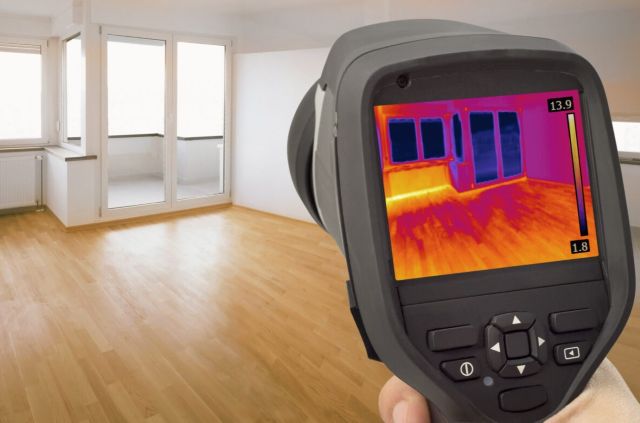
- Pyrometer or thermal camera. Allows detection of surface temperatures. If the difference from air temperature exceeds 4 °C, the surface is considered high risk - periodic condensation may form there;
- Particle counter (if available). An increase in the concentration of particles larger than 0.3 µm indicates the presence of dust, spore fragments, and microbial structures.
Instrument measurements are most informative when compared between different rooms. If rooms are similar in function and temperature, but one accumulates dust faster, has higher particle counts, stronger corner cooling, or a wetter ventilation grille, this points to localized hidden moisture or a ventilation problem, even in the absence of visible signs.
Mold-detection dogs
In some regions, dogs trained to detect mold and actinomycete odors are used. Their advantage is the ability to detect signs of microbiological activity even in hard-to-access zones: behind walls, under tiles, or in enclosed cavities.
What is important to understand
- Dogs respond to characteristic odors indicating the presence of mold, including hidden and inaccessible areas;
- This method does not replace moisture meters, thermal imaging, or visual inspection, but it can help localize areas with probable activity;
- Reliability depends on the dog’s training, indoor conditions, and the handler’s experience.
This method is not used as a sole diagnostic tool, but it may be applied as an additional method if such trained dogs are available in your area.
Additional methods that may also be applied
Ventilation and air movement
- Assessment of the condition of ventilation ducts and grilles. Dust, moist film, and odor are signs of organic buildup;
- Checking air pressure (negative pressure). If a space is under negative pressure, air is drawn in from walls, attic, basement, or adjacent spaces even without visible moisture. This creates hidden transport of spores, fungal fragments, and actinomycetes. The simplest test is to hold a sheet of paper or a thin tissue near a ventilation grille, window frame, or door gap: if it is pulled inward, the space is operating in infiltration mode. Additionally, draft in bathrooms and kitchens is assessed and air movement is compared between different rooms;
- Inspection of areas where condensation and dust accumulation commonly occur. These are typically exterior walls, cold corners, and areas behind furniture;
- Odor check after closing the space (build-up test). The room is tightly closed for 12-24 hours without ventilation, then opened and the odor is assessed. If a damp, earthy, or musty smell is present that was not noticeable during normal use, this indicates the presence of moist materials within the structure or accumulation of biofilms, even if there are no visual signs.
HVAC, ducts, and appliances
- Inspection of HVAC components and air ducts for hidden moisture zones. Inside cooling and ventilation systems, persistent “moisture points” often form that are not visible during routine inspection. Key risk areas include the evaporator coil, condensate pan, drain line, insulation sections that become wet from within, and duct segments passing through cold zones. Any moisture in these areas creates a stable biofilm that spreads spores and fragments even without odor or leaks. The same principles apply to air conditioners, heat pumps, and mini-split systems, where drain channels and moist evaporators often accumulate biofilm and can distribute aerosolized particles throughout the space;
- Inspection of appliance drainage systems (air conditioner, refrigerator, dishwasher). Any standing water is a stable moisture source.
Joints, finishes, and local structural defects
- Assessment of the condition of sealants and joints. Peeling, cracking, or discoloration are indirect signs of moisture beneath the surface;
- Checking infiltration through electrical outlets and switches. This is a common pathway for air entry from wall cavities. In winter, a cold draft may be felt by hand near an outlet or switch. A pyrometer or thermal camera can also be used to detect cooling around the electrical box, and odor is assessed when the cover is removed. If cold airflow or a damp smell is detected, this indicates hidden moisture or infiltration within the wall;
- Checking for temporary moisture stains that have already dried (transient moisture). Walls and finishes may become wet episodically and fully dry within 1-2 weeks without leaving visible marks. However, internal moisture can persist longer. To identify such zones, thermal imaging is used on different days, attention is paid to lines near the floor, traces of dried salts, uneven drying, and texture changes. Even without odor or stains, these signs indicate prior wetting of the structure and possible hidden microbial growth.
Room boundaries and neighboring sources
- Inspection of inter-unit boundaries. In multi-unit buildings, odors, particles, and humid air often pass through gaps around pipes, risers, outlets, ventilation shafts, and entry doors. Areas around risers and shared utilities should be checked, ventilation shafts assessed for reverse draft, and odors near the entry door or around pipes noted. If odor or airflow is detected at unit boundaries, the moisture or mold source may be located in an adjacent space.
External building elements
- Inspection of the building’s exterior perimeter. Moisture can penetrate the structure due to exterior issues. The condition of the perimeter and surrounding ground should be assessed: presence of standing water near the foundation and adequacy of soil slope. Check whether roof runoff discharges onto walls, whether there is siding damage, gaps, or signs of wetting. In humid climates, the presence of a ventilation gap (rain screen) is important; its absence increases the risk of hidden wall moisture. Any exterior defects can lead to moisture accumulation within walls without visible interior signs.
Seasonal changes
- Assessment of how the space behaves across seasons. Different seasons reveal different moisture sources. In winter, condensation on exterior walls and windows is more apparent; in autumn, negative pressure and air infiltration through gaps are more common; in summer, elevated HVAC humidity may indicate biofilm formation; in spring, issues with foundations, ground moisture, and drainage become evident. Observing seasonal changes helps identify hidden moisture zones that may not be apparent during a single inspection.
What to do if suspicious areas are found
When you identify a place where moisture persists, there is a stain, odor, or elevated humidity, it is important to act sequentially rather than simply “wiping and treating.” Mold is not a surface issue but a consequence of local physics: there is a moisture source or air stagnation somewhere.
Fix and assess
- Take photos and record hygrometer or moisture meter readings;
- Note the exact location - under a window, behind a cabinet, near a baseboard, under a sink;
- If there is an odor or a “cold” wall, this already indicates moisture beneath the surface.
Find the cause
- Condensation: Most often related to temperature differentials or poor air circulation;
- Gap or settlement: Water is drawn under tiles or sealant;
- Leak: Check pipes, traps, air conditioner drains, refrigerator drip trays;
- Ventilation: Weak airflow, reverse draft, dusty filters.
If the cause is not eliminated, any treatment will have only a temporary effect - the hotspot will return.
Act safely
- Do not open walls or floors without protection: respirator (N95 or P100), gloves, goggles;
- For a small area, first eliminate moisture and ensure thorough drying;
- If the area is large or the odor is strong, it is better not to disturb anything until evaluated by a specialist;
- If the affected area exceeds 1 square meter, specialists must be called for professional remediation; they will safely remove and dispose of contaminated materials.
Remove residues and microparticles
- After drying, perform wet cleaning using microfiber cloths;
- Use a vacuum cleaner with a HEPA filter - a regular vacuum will only spread spores;
- Check and clean HVAC filters, ventilation grilles, and air conditioners.
Recheck
- After 2-3 days, recheck the same area. If moisture has returned, the source has not been eliminated;
- If necessary, repeat measurements and inspect adjacent walls, floors, or ceilings.
Typical risk zones
Features of houses
In private houses, sources of moisture and mold differ from apartments. Additional factors include contact with soil, the roof, and large-scale ventilation systems - meaning zones where moisture can enter from below and above simultaneously.
Basements (basement). The basement is the most common zone of chronic moisture. Contact with soil, poor waterproofing, aging drainage systems, and temperature fluctuations cause persistent condensation on walls and pipes. If the basement feels cool and smells “earthy,” moisture is constantly present. Even without visible mold, the microenvironment there almost always contains mold spores.
Attics (attic). Attics are often underestimated. Temperature differences between the roof and the space below lead to condensation on the inner surface of the roofing. Damp insulation and insufficient ventilation create a stable zone for fungal growth.
The problem most often manifests in winter, when warm air from the house rises and meets cold air under the roof.
Crawl spaces (crawl-space). If a house is built on piers or has a low crawl space, air stagnation is common. The temperature is lower than inside the house, and moisture rises from the ground. Film and growth easily form on beams and the lower parts of floor structures, especially if there is no vapor barrier.
Ventilation and heating systems (HVAC, forced-air). Dust and condensation accumulate in air ducts, especially in bends and pans. If filters are not changed regularly, a layer of organic matter forms and is distributed throughout the house when the system operates. Condensate pans of air conditioners and heat pumps should also be checked - they often remain wet for months.
Foundation and drainage. Cracks, poor grading, or clogged drainage pipes allow moisture to seep inside. Even if water does not reach the floor, persistently moist soil around the foundation creates micro-capillary moisture transfer into the lower levels of the structure.
Features of apartments
In apartments, mold more often develops due to internal factors - temperature differentials, window condensation, and poor air circulation. There is no direct soil contact, but there are other persistent issues: glazed balconies, thin exterior walls, shared ventilation shafts, furniture placement, lack of windows in bathrooms, and furniture positioned tightly against cold walls due to limited space.
Windows and window sills. The most common cause of hidden condensation is the temperature difference between glass and air. Single-pane or old double-glazed windows, especially with aluminum frames, cool quickly and collect moisture. If the joint between the frame and the sill is not sealed, moisture penetrates inward and wets the wall. Window sills made of particleboard or MDF are often affected, where hidden decay and fungal growth begin.
Glazed loggias and balconies. The main issue here is the temperature differential between warm indoor air and cold glass. Even brief ventilation causes condensation that is absorbed into joints and sealants. If dust accumulates under the floor or in corners, a permanent micro-moisture zone forms.
Shared ventilation shafts. In many apartment buildings, ventilation functions unevenly: upper floors often have weak draft, while lower floors may experience reverse airflow.
Dust and spores settle in these shafts and are then drawn back into living spaces.
An additional risk is grease and moisture buildup on kitchen grilles and exhaust filters if they are rarely cleaned.
Niches along exterior walls and behind furniture. This is a classic issue in panel and monolithic buildings. Cold exterior walls create cooling zones, and when furniture is placed directly against them, air does not circulate. Stable condensation forms in corners and is gradually absorbed into paint or wallpaper. This most often occurs behind beds, wardrobes, and dressers along north-facing walls.
Kitchen joints and sealants. In apartments with dense layouts, kitchen and bathroom areas are often overloaded with moisture. If sealant around the sink or backsplash detaches from the wall, moisture is drawn under the surface and remains there. The same applies to joints near dishwashers, sinks, stoves, and kitchen panels.
Additional factors for first and top floors
- The first floor may have elevated humidity due to contact between the floor slab and a cold basement, parking garage, or soil beneath the building. A cold slab creates a temperature differential that leads to condensation in corners, along exterior walls, and beneath floor coverings;
- The top floor is exposed to risks similar to attic zones in houses: roof heating and cooling, poor ceiling-level ventilation, and a temperature gradient between the roof and the living space. This causes condensation beneath insulation, at floor slab joints, and in exterior wall niches;
- Apartments above garages or unheated spaces have colder floors. The temperature difference between the concrete slab and warm indoor air leads to condensation beneath floor coverings, especially in corners and along exterior walls;
- Apartments under flat roofs may experience increased humidity due to temperature fluctuations and insulation that retains moisture for extended periods beneath the roof.
These characteristics create additional hidden moisture zones that do not occur on intermediate floors and require separate attention during inspection.
Conclusion
Hidden mold develops where materials retain moisture and where sufficient air circulation is absent. These zones rarely present visible signs, so the key task is to identify where conditions supporting microbial activity are forming. Assessing temperature differentials, air behavior, hygroscopic materials, dust accumulation zones, and the condition of building systems allows identification of areas that remain unnoticed during routine inspection.
This approach is necessary both when selecting new housing and when assessing existing spaces. Laboratory tests, including ERMI, indicate the presence of mold contamination in a home but do not determine its location. To understand which specific area requires intervention or remediation, physical indicators must be analyzed: condensation, localized cooling, stagnant zones, damaged joints, moisture intrusion points, and HVAC components where interlayer moisture may exist.
Searching for a hidden source is a sequential inspection of all zones where water can accumulate and biofilms can form. This analysis makes it possible to determine which part of the structure or engineering system supports microbial growth and where cleaning or repair is required to eliminate the source of the problem.